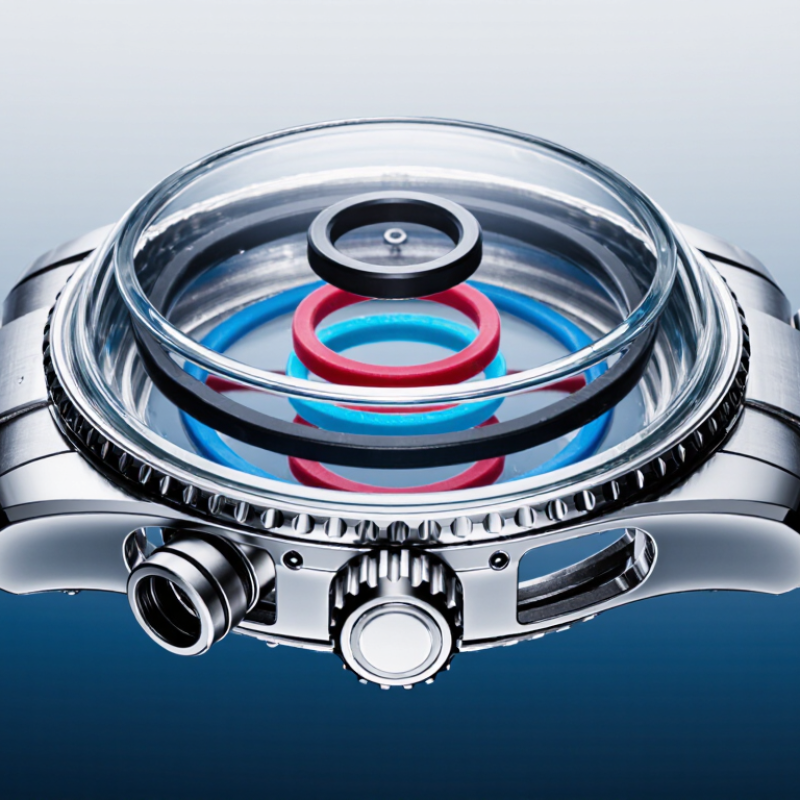
A diver watch’s gasket is a small component with a demanding job. It must seal the caseback, crystal, and crown while facing pressure, saltwater, heat, and repeated servicing. The right choice is not simply “the toughest rubber.” It is the compound that suits the watch’s design and real conditions of use.
ISO 6425:2018 sets requirements for diver’s watches, including water-resistance testing at a pressure above the watch’s stated rating. It does not prescribe one gasket material for every case. Parker Hannifin’s O-Ring Handbook likewise treats material selection as an application-specific engineering decision, shaped by media, temperature, pressure, and compression. Those are useful references, but neither replaces testing of the finished watch. A gasket can look perfect on a workbench and still fail after poor installation, aging, or a damaged sealing surface.
This guide explains how to choose the right gasket material for diver watch cases by comparing common elastomers, their strengths, and their trade-offs. EPDM, silicone, and FKM behave differently; none is universally best. Small details matter. A pinched crown seal, a nick near the caseback, or an incompatible lubricant can undermine a sound material choice. One limitation should be clear: no source articles were supplied, so I cannot verify a verbatim quotation from a named gasket expert. Rather than invent one, this introduction relies on published technical guidance and recognized testing standards. The material choice deserves the same care.
Define Dive-Watch Requirements: ISO 6425 Sets a 100 m Minimum
Choosing a gasket material for a dive watch starts with its rated purpose. ISO 6425 sets a 100-meter minimum for diving watches, but that number is not a complete design brief. The case must also withstand pressure, temperature changes, shocks, and repeated crown operation. A watch tested at 100 meters may still fail if its seals age or deform.
Material selection should match the case environment. Fluoroelastomer gaskets resist many oils, chemicals, and higher temperatures. Silicone remains flexible in cold conditions, but it can absorb gases and may tear during careless installation. Nitrile can work well in moderate service, although heat and long-term compression may reduce its performance. Check the case groove, gasket hardness, lubrication, and compression together. One component cannot compensate for a poor fit.
Small details matter. A dry gasket can twist when the caseback closes. Excess lubricant can attract dust. Both mistakes are common. Inspectors should check for cuts, flattening, and uneven contact before pressure testing. Replace seals after opening the case, even when they look acceptable. That practice adds cost, but visual inspection is imperfect. The 100-meter requirement should guide the design, not end the evaluation. Real reliability depends on material compatibility, controlled assembly, and documented pressure testing.
Map Case Joints and Measure Each Gasket’s Profile and Dimensions
Choosing the right gasket material starts with the case, not a catalog. During a dive-watch service, map every case joint before comparing elastomer options. Mark the crystal seat, case-back groove, crown tube, and pusher openings. Each joint experiences different pressure, movement, and friction. A case-back gasket may remain mostly stationary, while a crown seal stretches during winding. Small differences matter underwater.
Use a clean digital caliper, profile gauge, and bright inspection lamp. Remove the old gasket carefully, without scratching the groove. Measure groove width, groove depth, inner diameter, outer diameter, and cross-section. Record each value at three or four points around the joint. Cases can wear unevenly. Do not guess. Check whether the gasket is round, flat, rectangular, or shaped with a lip. Measure the unused seal when possible, because compression can distort the original profile.
Material selection should follow the joint’s actual conditions. Consider water exposure, temperature changes, compression set, flexibility, and contact with lubricants. A softer material may seal irregular surfaces, but it can extrude under pressure. A harder seal may resist movement, yet fail when the joint flexes. I once trusted a nominal diameter and ignored groove depth; the fit looked correct but compressed poorly. That mistake reinforced a useful habit: record measurements, inspect contact marks, and question any dimension that seems unusually convenient.
Compare NBR, FKM, Silicone, and EPDM for Water, Oils, and Temperature
Choosing a gasket for a dive watch case requires more than checking water resistance. The material must survive pressure, seawater, oils, and repeated temperature changes. ISO 6425:2018 tests dive watches for water resistance, condensation, shock, and other conditions, but it does not select the gasket compound for you.
NBR
NBR is a practical choice for general water exposure and mineral oils. Typical service ranges run from about -30°C to 100°C. However, it can harden faster under ozone and sunlight.
FKM
FKM usually handles oils and higher heat better, with common limits near 200°C. Its water performance is acceptable, yet hot water and certain chemicals may reduce service life.
Silicone
Silicone remains flexible near -60°C and can work well in cold environments. It often has weaker tear resistance and may swell in some oils.
EPDM
EPDM offers strong resistance to water, steam, and weathering. Typical ranges extend from roughly -50°C to 150°C. It should not be selected for petroleum oils without verification.
ASTM D395 compression-set testing helps compare permanent deformation after heat exposure. Lower compression set usually supports better sealing over time, but test results vary by compound and temperature.
The ranges are not promises.
In actual servicing, I inspect groove fill, surface scratches, and gasket compression before choosing a material. A perfect compound still fails in a damaged case.
I would also pressure-test the assembled watch after every gasket replacement, because laboratory data cannot reveal every field mistake.
Screen Elastomer Compatibility with ISO 1817 Liquid-Immersion Testing
Choosing a gasket for a dive watch case requires more than checking hardness or color. The elastomer must resist water, cleaning agents, skin oils, and assembly lubricants. ISO 1817 liquid-immersion testing provides a controlled way to compare these effects. It measures changes in mass, volume, hardness, and appearance after exposure to selected liquids.
Use test fluids that represent the watch’s real service conditions. Record the gasket’s dimensions before immersion. Keep temperature, exposure time, and fluid volume consistent. After testing, inspect swelling, cracking, tackiness, and surface deposits. A gasket may look acceptable yet lose elasticity. That hidden change can reduce sealing pressure during repeated case opening.
Material selection should match the complete design. EPDM often performs well with water-based exposure, while FKM can resist many oils and chemicals. Silicone remains flexible across temperature changes, but its mechanical strength may need closer review. These are starting points, not guarantees. ISO 1817 does not reproduce seawater pressure, salt deposits, or long-term compression in a watch case. Separate pressure, compression-set, and aging tests are still necessary.
In practical evaluations, a failed early test often reveals poor fluid selection rather than a bad material. That mistake is useful. Review the test liquid, fixture, and temperature before rejecting a candidate. Small changes in gasket geometry can also alter results. Measure twice. Record everything.
How to Choose the Right Gasket Material for Dive Watch Cases - Screen Elastomer Compatibility with ISO 1817 Liquid-Immersion Testing
Use this comparison as an initial material-screening guide for case-back, crown, and crystal seals. Compatibility depends on the exact compound, additives, cure system, fluid composition, temperature, and exposure time.
| Elastomer |
Seawater and Fresh Water |
Oils and Greases |
Heat, Ozone, and Aging |
Typical Selection Considerations |
EPDM
Ethylene propylene diene rubber |
Generally very good |
Poor with petroleum oils |
Typically strong resistance to ozone and weathering; service-temperature capability depends on compound. |
Often considered for water exposure. Avoid assuming compatibility with oil-based lubricants, petroleum products, or oily skin-care residues. |
FKM
Fluoroelastomer |
Generally good; verify compound |
Generally very good |
Often offers strong heat, ozone, and chemical resistance; low-temperature flexibility varies by grade. |
A common candidate where oils, heat, or chemical exposure matter. Confirm performance in the actual water, lubricant, and cleaning-fluid conditions. |
NBR
Nitrile rubber |
Usually serviceable; grade-dependent |
Generally good with many mineral oils and greases |
Ozone and outdoor-aging resistance is generally lower than EPDM or FKM; heat limits depend on formulation. |
May suit oil-contact applications, but assess long-term exposure to sunlight, ozone, and the specific aqueous environment. |
HNBR
Hydrogenated nitrile rubber |
Generally good; verify compound |
Generally good with many oils and greases |
Typically improves heat, ozone, and aging resistance compared with conventional NBR; exact limits are compound-specific. |
Can be considered when oil resistance and improved aging performance are both desired. Confirm low-temperature sealing needs for the application. |
VMQ
Silicone rubber |
Generally good |
Often poor with many hydrocarbon oils |
Often performs well across a broad temperature range; mechanical strength and tear resistance can be lower than some other elastomers. |
Useful where flexibility and temperature range are priorities. Check resistance to lubricants, abrasion, and assembly damage. |
ISO 1817 screening: ISO 1817 describes methods for evaluating the effect of liquids on vulcanized or thermoplastic rubber, including changes such as mass, volume, dimensions, and selected physical properties. Test representative production compounds in the relevant fluids at specified temperatures and durations. Results are material-screening data, not proof of dive-watch water resistance; the assembled watch still requires appropriate pressure and leakage testing. Sunscreens, detergents, and cleaning products vary widely, so test the actual formulations where exposure is expected.
Verify O-Ring Performance with ASTM D1414 and the Finished Watch with ISO 6425
A dive watch gasket must survive pressure, water, temperature changes, and repeated crown movement. Material selection starts with the case design, not a catalog color. Fluoroelastomer, nitrile, and silicone each respond differently to oils, heat, compression, and seawater exposure. A soft gasket may seal well initially. It can also deform after storage.
ASTM D1414 provides practical methods for measuring O-ring dimensions and testing properties such as tensile strength, elongation, hardness, and compression set. These measurements reveal how a gasket may behave inside a narrow case groove. Test samples should match the production compound and curing process. Otherwise, the data may look precise but describe the wrong seal. That mistake happens more often than teams admit.
The finished watch still requires separate verification under ISO 6425:2018. The standard addresses water resistance for divers’ watches and requires pressure-related testing at the watch level. Test pressure should follow the declared rating and approved procedure. Inspectors should check leakage after pressure exposure, thermal cycling, and operating the controls underwater when applicable.
A dry watch after one test is not enough. Caseback flatness, gasket lubrication, surface scratches, and assembly torque can change the result. I would record pressure, duration, temperature, and visible condensation for every sample.
Small details matter. An O-ring can pass ASTM measurements and still fail in a complete watch. That gap deserves review before production approval.
Conclusion
Choosing the right gasket material for diver watch cases begins with defining the watch’s performance requirements. A professional dive watch should be designed around the intended water-resistance rating, with ISO 6425 providing a 100-meter minimum reference for qualifying dive watches. Next, identify every case joint, including the crystal, case back, crown, and pushers, then measure each gasket’s cross-section, inner diameter, and installation space accurately. A correct profile and fit are just as important as the material itself.
When deciding how to choose the right gasket material for diver watch cases, compare NBR, FKM, silicone, and EPDM according to exposure to water, oils, chemicals, pressure, and temperature changes. Compatibility should be screened through ISO 1817 liquid-immersion testing, while O-ring dimensions and performance can be evaluated using ASTM D1414. Finally, test the fully assembled watch against ISO 6425 requirements to confirm that the complete sealing system performs reliably in real diving conditions.
 Ciso Tool
